
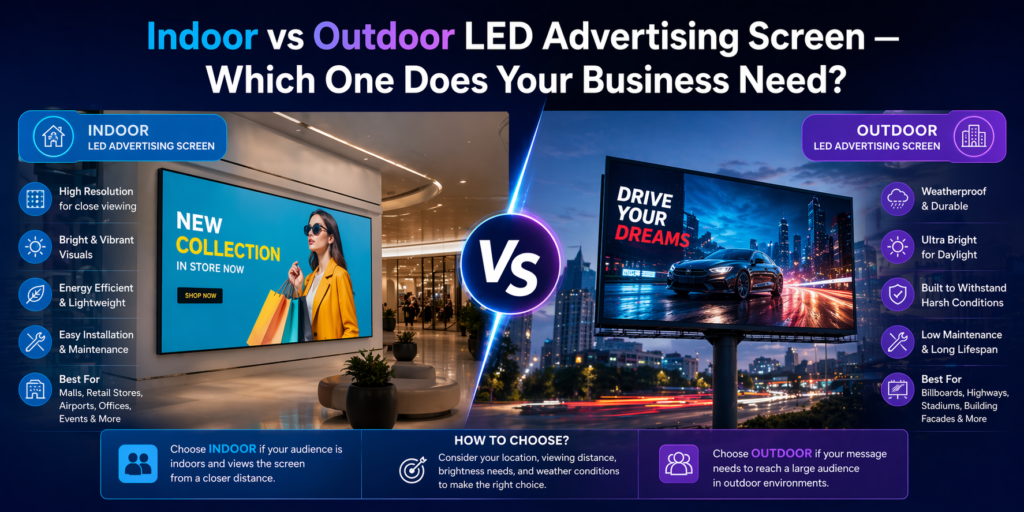
One of the most common questions business owners ask when investing in an LED advertising screen is: Should I go for an indoor or an outdoor screen? The answer is not always straightforward. The right choice depends on your location, content goals, budget, and viewing environment. This guide breaks down the key differences to help you make the most informed decision.
The Core Difference
The fundamental difference between an indoor and an outdoor LED advertising screen lies in brightness, weatherproofing, and pixel pitch.
Outdoor screens must overpower natural sunlight — which can reach up to 100,000 lux — while indoor screens operate in controlled, low-light environments. This single factor drives major differences in panel construction, power consumption, and price.
Side-by-Side Comparison
| Feature | Indoor LED Advertising Screen | Outdoor LED Advertising Screen |
| Brightness | 800–2,000 nits | 5,000–10,000 nits |
| Pixel Pitch | P1.5 – P4 | P4 – P16 |
| IP Rating | IP20 – IP43 | IP65 – IP69 |
| Viewing Distance | 1–8 metres | 8–50+ metres |
| Cabinet Material | Light aluminium | Heavy-duty steel/aluminium |
| Weatherproofing | Not required | Fully waterproof, dustproof |
| Power Consumption | Lower | Higher |
| Common Applications | Lobbies, malls, meeting rooms | Hoardings, facades, roadside |
Sunshine Display System manufactures both categories, with IP ratings from IP20 for indoor all the way to IP69 for extreme outdoor conditions.
When to Choose an Indoor LED Advertising Screen
Indoor LED advertising screens are the right choice when your audience is in a controlled environment — inside a building, walking through a corridor, or seated in a meeting room.
Here are the most common use cases:
- Retail Showrooms: Display product features, running offers, and brand videos at the point of sale.
- Corporate Lobbies: Make a powerful first impression on visitors with a high-resolution LED video wall.
- Restaurants & Cafeterias: Digital menu boards powered by indoor LED screens can be updated instantly without reprinting.
- Conference Rooms: Large format indoor LED screens replace projectors for sharper, brighter presentations.
- Banking Halls: Token display systems and interest rate boards are staple indoor LED applications.
Sunshine Display System’s indoor solutions include meeting room LED screens, conference room LED screens, lobby LED screens, and menu bar LED screens — all designed for corporate and commercial environments. For indoor applications, pixel pitch as fine as P2MM ensures crystal-clear image quality when viewers are standing just a few metres away.
When to Choose an Outdoor LED Advertising Screen
Outdoor LED advertising screens are built to perform in India’s most demanding climatic conditions — summer heat, monsoon rain, and coastal humidity. If your audience is on the street, in a parking lot, or passing by a building, an outdoor screen is the right investment.
Key outdoor applications include:
- Roadside Hoardings: Replace expensive static flex banners with a dynamic outdoor LED advertising screen that can run multiple campaign creatives simultaneously.
- Building Facades & Wraps: Large outdoor LED panels can cover entire building exteriors, turning them into massive advertising canvases.
- Petrol Stations & Malls: Attract foot traffic from a distance with bright, motion-rich advertising content.
- Sports Arenas: Outdoor LED screens with fast refresh rates display live scores and event feeds without lag.
- Mobile Advertising Vans: Sunshine Display System’s LED mobile vans and trucks bring the screen to your audience — ideal for product launches, political campaigns, and roadshows across India.
Brightness: The Game-Changer for Outdoor Screens
If there is one specification that separates indoor and outdoor LED advertising screens, it is brightness. A screen at 1,000 nits looks stunning indoors but is practically invisible under direct sunlight.
Outdoor LED advertising screens from Sunshine Display System are designed to deliver 5,000–8,000 nits, ensuring your content cuts through even harsh Indian summer sunlight. Many outdoor models also feature auto-brightness sensors that adjust screen luminosity based on ambient light conditions, reducing power consumption at night.
IP Ratings Explained — Why They Matter for Outdoor Screens in India
The IP (Ingress Protection) rating tells you how well a screen is sealed against dust and water. For outdoor use in India, a minimum of IP65 is recommended. This means the screen is completely dustproof and protected against water jets from any direction.
Sunshine Display System’s product range covers the full IP spectrum:
- IP20 — Indoor screens, basic protection
- IP54 — Splash-proof, semi-outdoor environments
- IP65 — Fully outdoor, rain and dust protected
- IP67 — Can withstand temporary submersion in water
- IP69 — High-pressure, high-temperature water jet resistance for extreme environments
Making the Final Decision
Here is a quick checklist to help you decide:
- Is your screen going to be exposed to rain, dust, or direct sunlight? → Choose Outdoor
- Will your audience be within 5 metres of the screen? → Choose Indoor (fine pixel pitch)
- Do you need a large-format screen visible from 30+ metres? → Choose Outdoor
- Is your screen going inside a corporate lobby, conference room, or retail store? → Choose Indoor
- Do you need a moving advertising screen for events or campaigns? → Choose LED Mobile Van
Sunshine Display System’s expert team provides end-to-end consultation to help businesses select the right LED advertising screen based on location, content goals, viewing angle, and budget — ensuring maximum ROI on every installation.
Frequently Asked Questions (FAQs)
Q1. Can an indoor LED advertising screen be used in a partially outdoor space like a covered parking?
Yes, but you need a screen with at least an IP54 rating for splash and dust protection. Sunshine Display System’s semi-outdoor range is specifically designed for environments like covered parking areas, open-air malls, and canopied storefronts.
Q2. How long does an outdoor LED advertising screen last in Indian weather conditions?
Commercial-grade outdoor LED advertising screens are designed to last 50,000–100,000 hours (approximately 10+ years) when maintained properly. Sunshine Display System’s outdoor panels use high-grade weatherproof cabinets rated up to IP69.
Q3. What is the minimum brightness needed for an outdoor LED advertising screen in India?
For standard outdoor conditions, a minimum of 5,000 nits is recommended. For screens installed in direct sunlight with no shade (e.g., rooftop hoardings), 7,000–8,000 nits is ideal.
Q4. Are indoor LED advertising screens available for rent?
Yes. Sunshine Display System offers both indoor and outdoor LED video wall screens on rent for events, exhibitions, product launches, and corporate conferences across India. Q5. Can I control both indoor and outdoor screens from a single platform?
Absolutely. Sunshine Display System’s screens support a unified content management system compatible with Android and Windows, allowing centralised control of multiple screens from a single dashboard.