
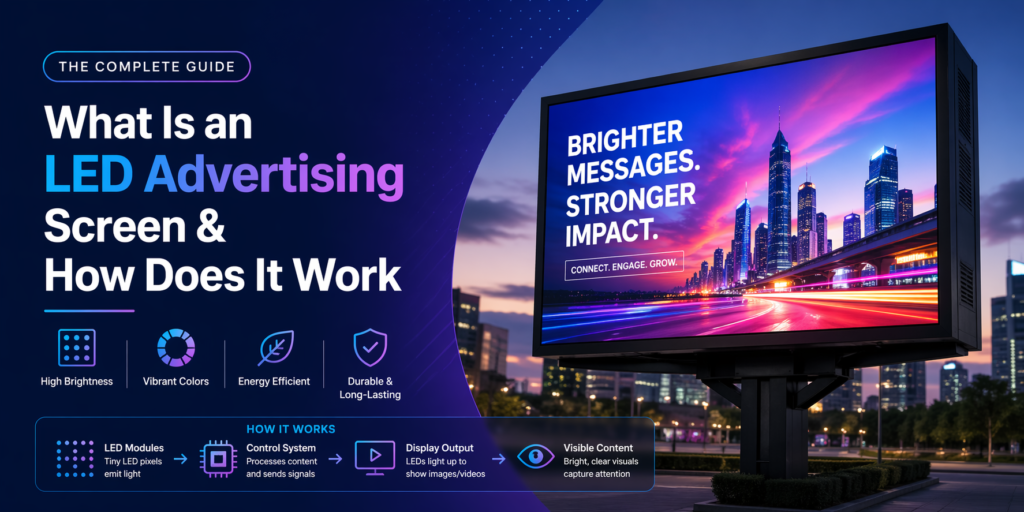
Walk through any busy Indian market, airport, or shopping mall, and you will notice one thing that instantly commands attention — a bright, vivid LED advertising screen playing videos, announcing offers, and broadcasting brand messages. These displays have quietly replaced traditional flex banners, hoardings, and backlit boards across India. But what exactly is an LED advertising screen, and how does it actually work? If you are a business owner, event organiser, or brand manager looking to understand this technology before investing, this guide is for you.
What Is an LED Advertising Screen?
An LED advertising screen is a flat-panel digital display that uses Light Emitting Diodes (LEDs) to produce bright, high-resolution visual content for marketing and advertising purposes. Unlike a traditional printed banner or a backlit sign, an LED advertising screen can show dynamic content — including videos, slideshows, live feeds, social media updates, and real-time information — all managed remotely through a content management system (CMS).
At Sunshine Display System, these screens are designed and manufactured to serve a wide variety of industries — from retail showrooms and corporate lobbies to outdoor hoardings, event stages, and mobile advertising vans. As a leading manufacturer of LED-based display systems in India, Sunshine Display System supplies both fixed installation and rental LED advertising screens across the country.
How Does an LED Advertising Screen Work?
Every LED advertising screen is made up of thousands of tiny LEDs arranged into modules. Each LED module contains clusters of Red, Green, and Blue (RGB) diodes that, when combined in different intensities, produce over 16 million colours. These modules are tied together to form the full display panel.
Here is a simplified breakdown of the working mechanism:
- Content Input — Your advertising content (video, image, or text) is uploaded via a connected computer, Android device, or media player.
- Signal Processing — A controller card or receiving card processes the digital signal and distributes it across the LED modules.
- LED Module Rendering — Each pixel on the screen lights up at the precise brightness and colour to render the image.
- Real-Time Refresh — Modern LED advertising screens refresh at a minimum of 3840 Hz, ensuring flicker-free, smooth playback of video content.
Sunshine Display System’s screens are compatible with Android, Windows, and proprietary Sunshine Media Players, allowing seamless control from any device in any location.
Key Technical Terms You Should Know
Understanding these technical terms will help you make a smarter purchase decision:
- Pixel Pitch (P value): The distance in millimetres between the centre of one pixel and the next. A lower P value (e.g., P2) means higher resolution and is ideal for close viewing distances. A higher P value (e.g., P10) is suited for outdoor advertising viewed from a distance. Sunshine Display System offers modules from P2MM to P16MM and beyond.
- Brightness (Nits): Measured in candelas per square metre (cd/m²). Outdoor LED advertising screens typically require 5000–8000 nits to remain visible in direct sunlight.
- IP Rating: The Ingress Protection rating defines resistance to dust and water. Sunshine Display System’s screens comply with IP standards ranging from IP20 (indoor) to IP69 (heavy outdoor environments).
- SMD vs COB LED: SMD (Surface Mounted Diode) LEDs are individually mounted and offer wide viewing angles. COB (Chip on Board) LEDs are newer and provide even greater durability and uniformity.
- Refresh Rate: Higher refresh rates (3840 Hz+) prevent flickering in camera footage — essential for advertising screens captured in photos and videos.
Types of LED Advertising Screens
LED advertising screens are not one-size-fits-all. Depending on your use case, location, and budget, the right screen type will differ:
- Indoor LED Advertising Screen — Used in malls, lobbies, showrooms, restaurants, and conference rooms. Typically, fine pixel pitch (P2–P4) with lower brightness (800–1500 nits).
- Outdoor LED Advertising Screen — Built for hoardings, building facades, petrol stations, and roadside advertising. Requires higher brightness (5000+ nits) and weatherproofing.
- LED Video Wall — A tiled array of LED panels used for large-format indoor or outdoor displays. Sunshine Display System’s video walls are bevel-edge free and offer deep customisation.
- LED Sign Board — A smaller, focused advertising sign ideal for storefronts, clinics, restaurants, hotels, and pharmacies.
- LED Mobile Van — A moving LED advertising screen mounted on vehicles, ideal for political campaigns, product launches, and roadshows. Sunshine Display System specialises in managing end-to-end LED mobile van campaigns across India.
- Transparent / Glass LED Screen — A see-through LED display used in glass facades and retail window displays for a modern, premium aesthetic.
Why Businesses in India Are Switching to LED Advertising Screens
The shift from traditional advertising media to LED advertising screens is happening rapidly across India. Here is why:
- Higher Visibility: An LED advertising screen with 6500 nits brightness remains clearly visible even under harsh afternoon sunlight.
- Dynamic Content: Unlike a static banner, you can update your advertising content in real time — promoting flash sales, event countdowns, or live news.
- Cost Efficiency: While the upfront investment is higher, LED screens eliminate recurring printing costs. A single screen can run different campaigns for multiple clients simultaneously.
- Long Lifespan: Commercial-grade LED advertising screens typically last 50,000–100,000 hours, translating to over 10 years of operational life.
- Eco-Friendly: LED technology consumes significantly less energy compared to older neon or fluorescent advertising boards.
Sunshine LED Display System has deployed over 25,000 screens globally, working with brands across retail, finance, automotive, and entertainment sectors. Their end-to-end service model — from design and manufacturing to installation and after-sales support — makes them a preferred partner for businesses across India.
Where Are LED Advertising Screens Used?
LED advertising screens from Sunshine Display System have found applications across virtually every industry:
- Retail: Product promotions, in-store digital signage, menu boards at restaurants
- Corporate: Meeting room displays, conference room screens, lobby video walls
- Banking & Finance: Digital rate boards, interest rate displays, token display systems
- Events: Stage backdrops, LED curtains, rental video walls for concerts and exhibitions
- Transportation: Arrivals and departures boards at airports and railway stations
- Outdoor Advertising: Roadside hoardings, mall facades, sports scoreboards
Frequently Asked Questions (FAQs)
Q1. What is the difference between an LED advertising screen and an LCD screen?
LED advertising screens use individual light-emitting diodes for each pixel, delivering much higher brightness, better outdoor visibility, and modular scalability. LCD screens are backlit flat panels ideal for small indoor setups but are not suited for large-scale outdoor advertising.
Q2. Can LED advertising screens be used outdoors in India?
Yes. Outdoor LED advertising screens are specifically engineered to handle India’s climate — from intense sunlight to monsoon rains. Sunshine Display System’s outdoor screens carry IP65 and IP67 ratings, making them fully weatherproof.
Q3. What pixel pitch should I choose for my LED advertising screen?
This depends on your viewing distance. For indoor screens viewed from 2–5 metres, P2–P3 is ideal. For outdoor screens viewed from 10+ metres, P6–P10 works well. Sunshine Display System’s team helps clients select the right pixel pitch for their specific installation environment.
Q4. How is content managed on an LED advertising screen?
Content is managed through a CMS (Content Management System). Sunshine Display System screens support Android, Windows, and their proprietary Sunshine Media Player, allowing remote content updates from any location.
Q5. Are LED advertising screens energy-efficient?
Yes. Modern LED advertising screens consume significantly less power than traditional neon or fluorescent signage. Outdoor LED screens with auto-brightness adjustment further reduce power consumption based on ambient light.